Who is Bernardo Fort-Brescia?
Bernardo Fort-Brescia is the founding principal of Arquitectonica, the Miami-based architecture firm he co-founded in 1977. His curvilinear forms, bold colors, and tropical-modernist sensibility have defined Miami’s skyline for more than four decades and influenced a generation of South Florida architects.
Fort-Brescia’s early work (particularly the Atlantis on Brickell with its iconic palm-tree-and-jacuzzi cutout) signaled that Miami architecture would not be a copy of New York or Los Angeles. It would have its own visual grammar: hot colors, geometric play, and a relationship to the climate and the water that read as specifically Floridian.
Today, Arquitectonica is one of the most prolific firms working in Miami, with projects ranging from the American Airlines Arena to a long list of branded residential towers. Fort-Brescia remains directly involved in the firm’s flagship projects.
What is the curvilinear language?
The curvilinear language at Arquitectonica means floor plates flex and bend rather than meeting at right angles. Buildings appear to twist or wrap around their sites, which maximizes view corridors, breaks up the visual massing of tall towers, and gives every residence an exterior moment rather than only the corner units.
From the inside, the curves matter because they push the building’s structure to the perimeter in ways that open up the interior. Wrap-around terraces become possible. View corridors widen. Light enters from multiple angles throughout the day, not just morning or afternoon.
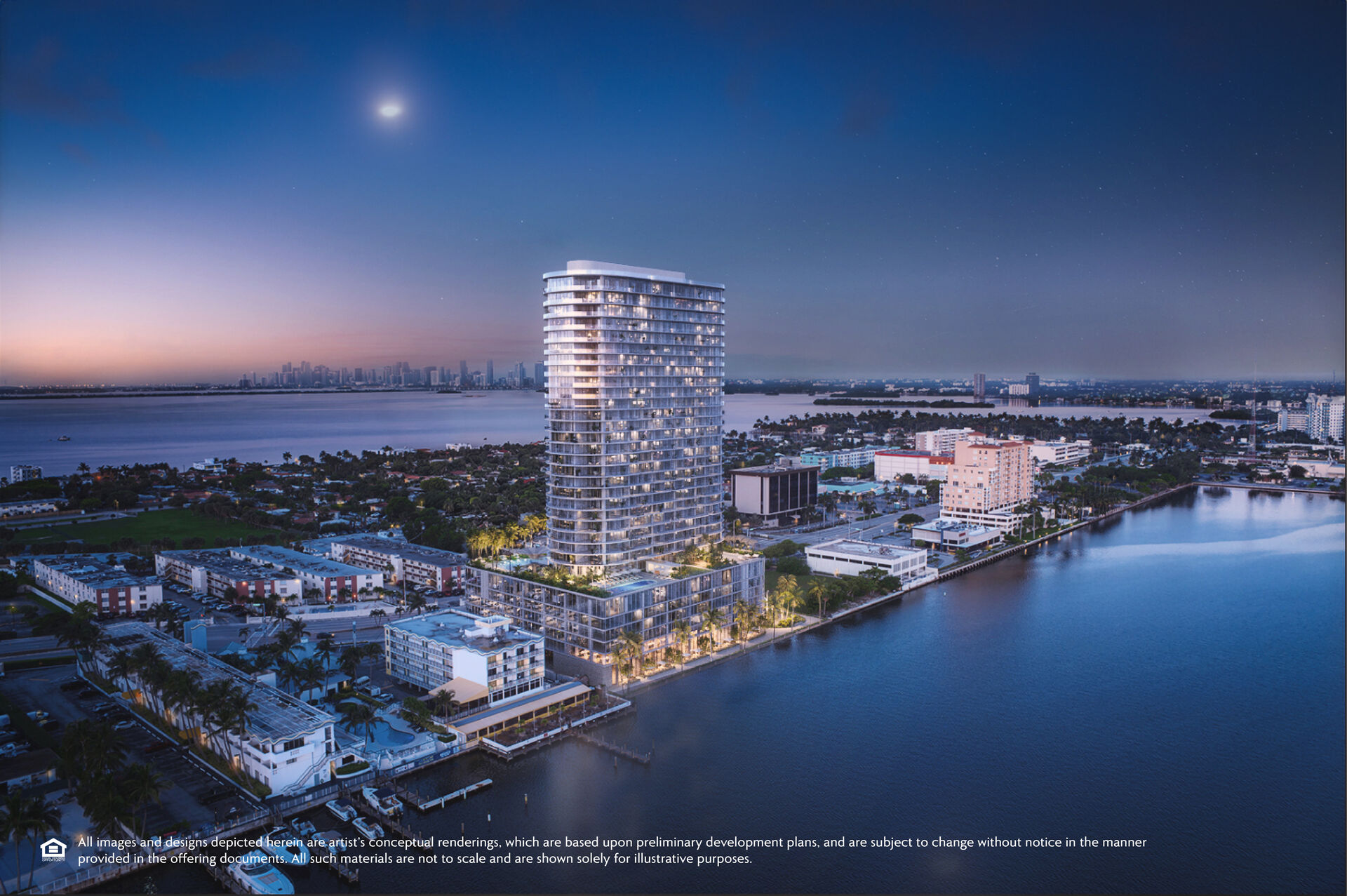
From the outside, the curves matter because they soften the building’s impact on the waterfront. A rectangular tower reads as a wall; a curved tower reads as a sculpture. For waterfront sites where the surrounding views are part of the value, that distinction is the whole game.
How does the language show up at Continuum?
At Continuum, the curvilinear language produces 80-foot protected view corridors, wrap-around terraces on every residence, and a building footprint that flexes along the 300-linear-foot waterfront edge. The form gives each home a unique exterior orientation rather than treating residences as identical floor plates stacked vertically.
The 80-foot view corridors are the most consequential design move. Most luxury Miami towers concentrate the best views on the corners and treat the middle units as a secondary tier. Continuum’s curved geometry distributes views. Every residence has a wide outdoor moment, not just the four corner units per floor.
The terraces are similarly distributed. Residence 04, for example, has 723 SF of exterior space on a 1,958 SF interior, nearly 27% of the home’s footprint is outdoor. That ratio is possible because the curved floor plate gives the architects more perimeter to work with.
What other Miami buildings has Arquitectonica designed?
Beyond the Atlantis on Brickell and American Airlines Arena, Arquitectonica’s Miami portfolio includes major branded residential towers, mixed-use developments, hospitality projects, and cultural buildings. The firm has shaped the visual identity of Brickell, Edgewater, Wynwood, and now North Bay Village.
For pre-construction buyers, an Arquitectonica building carries a particular kind of confidence: the architect has been doing this in Miami longer than almost anyone, and the firm understands the climate, the construction realities, and the buyer expectations specific to South Florida luxury condominiums.
Continuum extends that track record into North Bay Village. The first major branded development in the village since the 2020 rezoning is being designed by the architect most responsible for defining what Miami architecture looks like in the first place.